The project develops adaptive and creative teaching-and-learning solutions for initial and continuing training in the electrical trades. The main focus is on establishing and testing a modern, assisted digital learning process companion equipped with AI tools. This system is designed to integrate more effectively into everyday workplace processes and to enable work-process-oriented learning through increased location- and time-independent learning phases.

Projects
Learning in the Electrical Trades with Artificial Intelligence – Acronym: Learn with AI

HoloSpaceXR – Immersive XR Technology for Hybrid Meetings
The validation project HoloSpaceXR develops an innovative, immersive Extended Reality (XR) solution designed to revolutionize hybrid meetings. Using virtual and augmented reality, the project enables an equal and interactive meeting experience: remotely connected participants appear as spatially positioned avatars within the physical room, complete with spatial audio.
The ERDF Validation Funding Programme 2021–2027 supports research institutions in Free State of Saxony with grants of up to 90% to test and further develop innovative research results for practical economic applications. The program aims to strengthen technology transfer and promote forward-looking innovations within the region.
The goal is the technical and market validation of a prototype, supported by the ERDF program (2021–2027). Initiated by the New Work Design Lab (NWDL) under the leadership of Marius Brade together with the team Lehnart, Lentzsch, Lenz, and Maurer, HoloSpaceXR aims to enable “meetings at eye level” and establish new standards for collaboration, education, and event communication.
With this project, a forward-looking solution is being created for the increasing hybridization of the modern workplace—where technological innovation meets societal relevance.

Entrepreneurship Initiative dresden|exists (IMEI-ddex2024-FHD)
With the ESF Plus Funding Guideline for Start-up Initiatives, the development of a culture of entrepreneurship and self-employment at academic institutions in Free State of Saxony is being supported. The project “Entrepreneurship Initiative dresden|exists (IMEI-ddex2024)” implements innovative measures to promote entrepreneurial knowledge, test new approaches, and strengthen networking.
Under the umbrella of dresden|exists, several universities combine their offerings in the areas of prototyping, bootcamps & masterclasses, as well as founder personality development and co-founder matching.
Fachhochschule Dresden (FHD) plays a key role in the Prototyping module.

Entrepreneurship Initiative dresden|exists (SMEI-ddex)
The initiative SMEI-ddex (Startup and Mobility Entrepreneurship Initiative dresden|exists) builds on the long-standing success of dresden|exists—a cross-institutional network that promotes entrepreneurship and academic spin-offs from the research and higher-education system.
The aim is to support students, academic staff, and graduates in the Dresden and Lusatia region in identifying innovative ideas, developing entrepreneurial skills, and taking the step toward founding their own start-ups.
To achieve this, the initiative focuses on four key areas:
-
Information
-
Qualification and training
-
Idea generation
-
Start-up support

Photovoice E55 – Reflecting Social Inequality Through Images / Photovoice E55 – Reflexe sociálních nerovností prostřednictvím obrazů
The North Bohemian spa town of Dubí—located near the border with Saxony and crossed by the European route E55—developed after 1989 into what was often referred to as the “longest street prostitution zone in Europe.” Around 50 brothels existed along Ruská Street, which connects Teplice with Zinnwald-Georgenfeld, and estimates suggested that up to 400 sex workers were operating there, often serving clients from Germany. On the Czech side, this development was sometimes sarcastically described as a “toll on the way into the European Union.”
In 2006, the motorway from Dresden to Ústí nad Labem was opened. One year later, Czech Republic joined the Schengen Area, eliminating border controls and the long waiting times at the border.
What did it mean to live in a social environment known across much of Europe for its reputation as a paradise for paid sex?
How do people on both sides of the border region deal with the mentality of cross-border clients and a “cheap-is-cool” culture in which some believe that everything can be bought for ten euros?
What does social inequality mean for people in this cross-border social space? How is it perceived, and where does it manifest?
And what has happened 15 years after sex work lost part of its economic foundation following the disappearance of heavy freight traffic along the E55?

“3 hoch 3” – DAAD Eastern Partnerships
Within the framework of the German Academic Exchange Service (DAAD) Eastern Partnerships program, Fachhochschule Dresden (FHD), the Johann-Weiher Theological College (JWTC)* and the Orthodox Research Center for Socio‑Religious Studies (OR-ZSE)* organize study days in preparation for a future bilateral Summer School on Diversity.
The target group includes students from the fields of Applied Social Sciences, Social Work, Environmental Security, Theology and Religious Studies, Education Science, and Social Work and Social Studies.
The program addresses various aspects of diversity in teaching, professional practice, and society and includes lectures, discussion rounds, field visits, and excursions.
Students and lecturers from the participating departments will have the opportunity to exchange, deepen, and expand their knowledge and understanding while establishing international contacts. In thematic workshops, students and faculty members from the three universities collaboratively explore shared professional perspectives across national and regional borders, as well as possible approaches for international social work that responds to transnational migration, asylum and refugee movements, and broader cultural and religious transformations.
Topics also include practical ethics, youth and family work, migration phenomena, professionalization, and cultural change, alongside a comparative examination of institutional frameworks and understandings.
Traveling Tools – Diversity-Sensitive Method Toolkits for Early Childhood Education in the Dresden and Saxon Switzerland–Ore Mountains Region
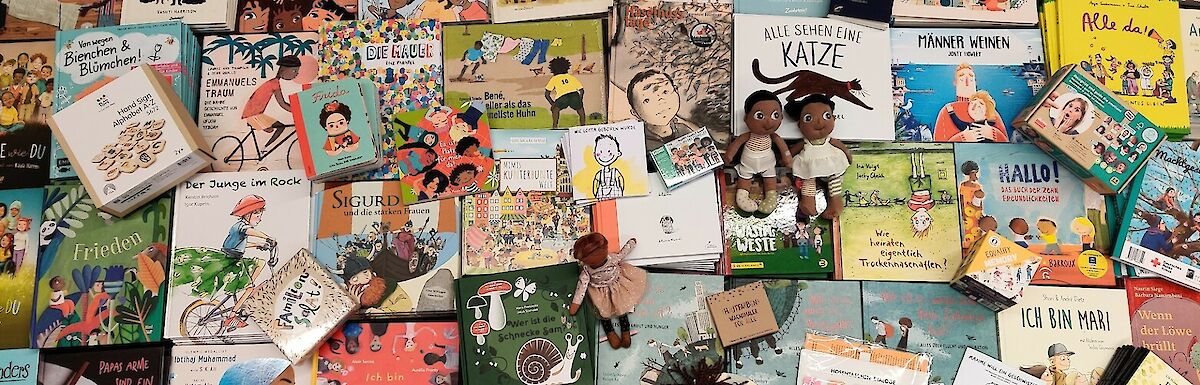
The diversity-sensitive method toolkits are traveling across Dresden. The toolkits can be borrowed free of charge through Fachhochschule Dresden (FHD). A total of two toolkits are available for daycare centers and after-school care facilities.
Educational institutions can test the materials contained in the toolkit for 6–8 weeks before the toolkit moves on to the next daycare center or after-school program. To help professionals on site become familiar with the topic and the materials, each toolkit includes a guidebook.
In addition, Fachhochschule Dresden can also be contacted to provide training sessions related to the toolkit and its themes.
If you are interested in borrowing a toolkit or learning more about the project, please feel free to get in touch via email.
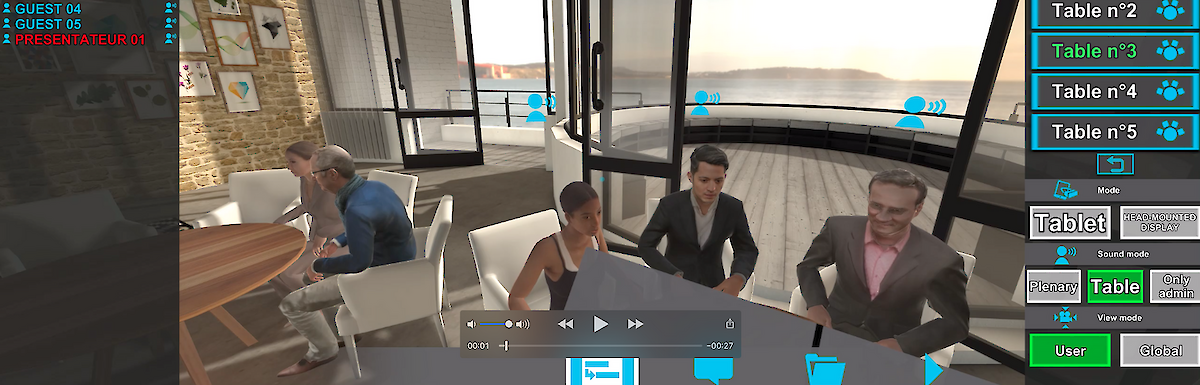
ROLEPL-AI - Remote training with AI-supported simulation in the metaverse for vocational education and training in management
The Erasmus+-funded project is developing an innovative AI-supported simulation for vocational education and training in management. The remote training combines immersive technologies with artificial intelligence to create practical learning environments in the metaverse. The aim is to train and develop soft skills and conflict management in a targeted manner. Dresden University of Applied Sciences is responsible for the development of practice-oriented use cases and scenarios, while international partners are jointly driving the project forward. ROLEPL-AI offers companies and educational institutions new opportunities for digital qualification and creates future-oriented learning formats.
Evaluation of the KOMPAKT step-by-step model at the Jobcenter Dresden
The KOMPAKT measure - “Competent activation of participants” - supports employable benefit recipients in the Dresden area through targeted activation and integration measures. The aim is to sustainably integrate participants into the labor market through individual counseling, socio-educational support and practical occupational field trials. The two-stage combination of measures specifically promotes the development of alternative courses of action and strengthens self-efficacy. The accompanying evaluation examines the effectiveness and implementation of the measure using qualitative and quantitative methods. The focus is on the participants' perspectives, while theoretical models such as the expectation of self-efficacy or the theory of transition markets serve as a framework for reflection. The evaluation project is managed by the Sächsisches Umschulungs- und Fortbildungswerk Dresden e. V. and is based on the standards of the German Evaluation Society.

CANDI – CAPACITY IN DIGITAL VET TEACHING
The Erasmus+-funded project is committed to promoting the digital skills of teachers in vocational education. An innovative workshop curriculum is being developed in collaboration with partner institutions from Germany, Albania, Bosnia and Herzegovina and Spain. The aim is to prepare teachers for the challenges of digital change and provide them with practical methods for teaching. The blended learning concept enables flexible and effective further training in the national languages Bosnian and Albanian. Dresden University of Applied Sciences is responsible for the technical implementation of the digital learning platform. At the end of the project, a transfer concept will be drawn up to support schools in developing their own training courses. CANDI is making an important contribution to the digital transformation of vocational education and training.

G4C:NGE – Playful Learning in Next Generation Entrepreneurship
The Erasmus+ project focuses on playful learning to inspire students to start a business in a playful way. In collaboration with five European universities, an innovative curriculum for Next Generation Entrepreneurship (NGE) is being developed that integrates gamification elements into management training. Students learn in a practical way how they can use playful approaches to develop creative business ideas and design sustainable business models. The project provides methods, toolkits and training for lecturers on how to use gamification effectively in teaching. A central online platform offers teachers inspiration and materials for the classroom. With a total of 9 ECTS credits and practical content, G4C:NGE promotes the development of digital skills and innovative teaching methods. Together we create European added value for the start-ups of tomorrow!
Skilled worker guideline for securing skilled workers in the Free State of Saxony - Scientific support as part of the conception, planning and marketing of the DEHOGA project “HoGa-Nachwuchskräfte: Finden-Binden-Vernetzen” (finding, retaining and networking)
The joint project of the Dresden University of Applied Sciences (FHD) and DEHOGA Sachsen e.V. is actively committed to securing skilled workers in the hotel and catering industry. The aim is to increase the attractiveness of hospitality professions, attract young talent and network companies with potential skilled workers. Whether young people, career changers or international applicants - the project offers sustainable solutions for recruiting skilled workers. Targeted communication measures and the provision of internships make it easier to enter the industry and create long-term prospects. This not only counteracts the shortage of skilled workers, but also secures the future of the industry.

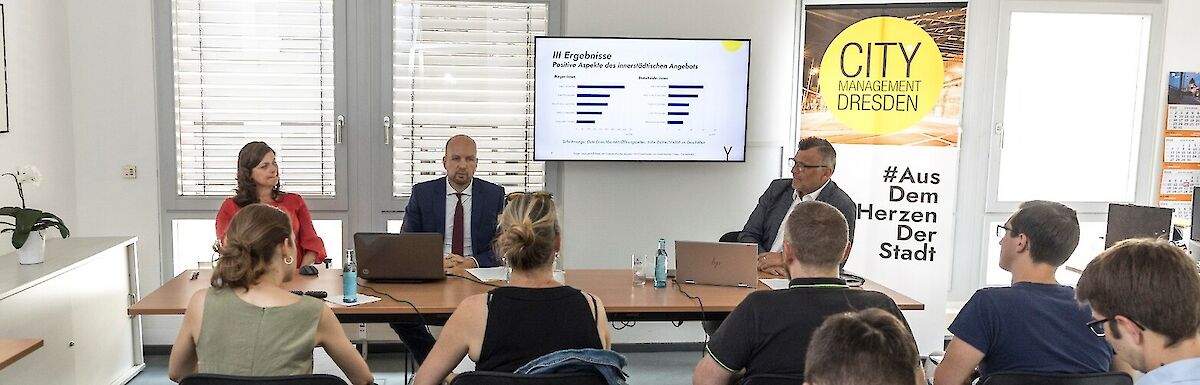
Vacancy analysis Dresden city center
How can vacancies in Dresden's city center be sustainably reduced? As part of a comprehensive vacancy analysis, the FHD is working together with City Management Dresden e.V. and Elbmind GmbH to gain valuable insights. A broad-based survey of citizens and city center stakeholders is intended to capture their needs and perspectives. The aim is to create a sound database for future urban development processes. The FHD is responsible for the scientific design of the survey and the analysis of the results. To ensure the neutrality and credibility of the study, the interim results and the final presentation will be presented to representatives of the press.
Guideline for skilled workers - Feasibility analysis for university practice teaching centers in the district of Saxon Switzerland Osterzgebirge in the tourism industry
How can universities and companies in the Sächsische Schweiz-Osterzgebirge district work more closely together to counteract the shortage of skilled workers? The feasibility study on university-practice teaching centers examines the potential and implementation possibilities for cooperation in the fields of tourism, marketing, event management, nursing and healthcare. A comprehensive needs analysis using online surveys and interviews is used to identify structural challenges and specific regional needs. The aim is to develop recommendations for action in order to exploit synergies between science and business and to sustainably strengthen the recruitment of skilled workers.

DD-REGIOplus
Since 2020, Fachhochschule Dresden (FHD) has been actively involved in the joint project DD-REGIOplus to provide targeted support for those interested in starting a business. The focus is on UX design and prototyping, which enables innovative business ideas to be developed faster and in a more market-oriented way. The FHD offers practical workshops, start-up advice and direct exchange with experts. Students benefit from free access to many offers and can further develop their ideas with professional support. Together with strong partners such as TU Dresden and other research institutions, the FHD helps to strengthen Dresden's start-up ecosystem.

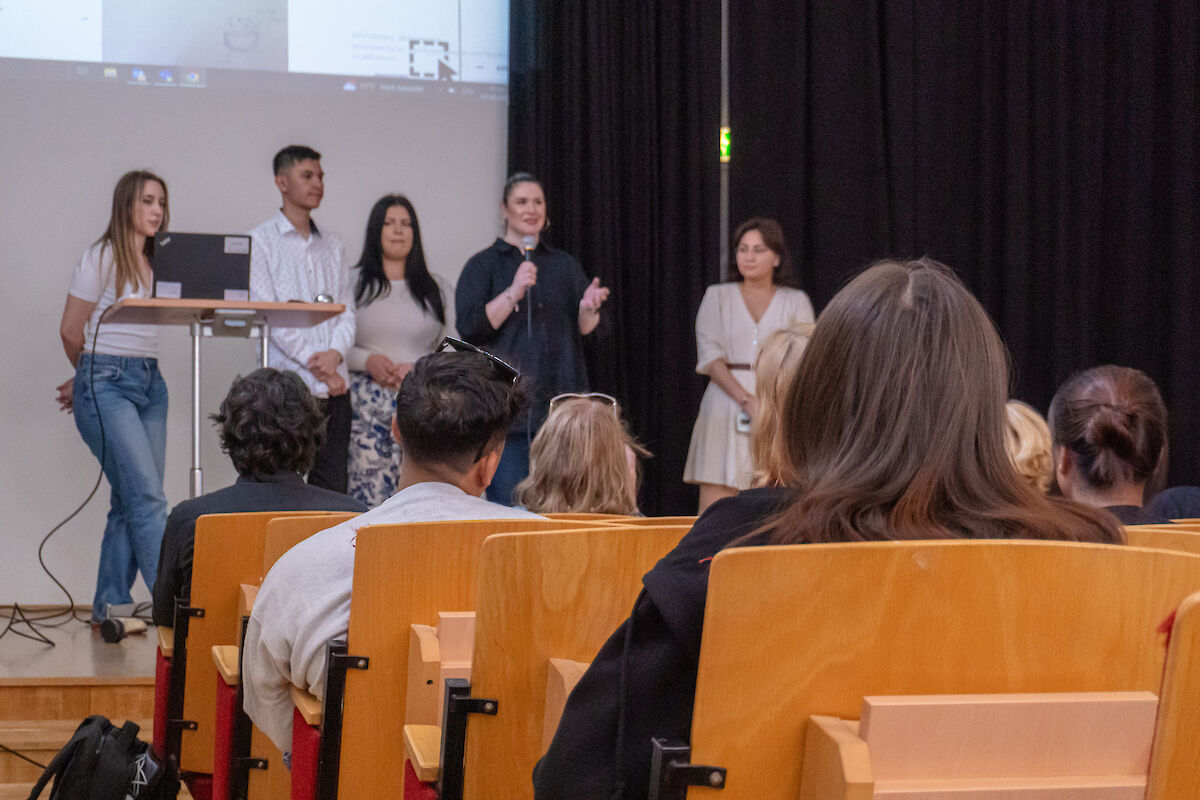
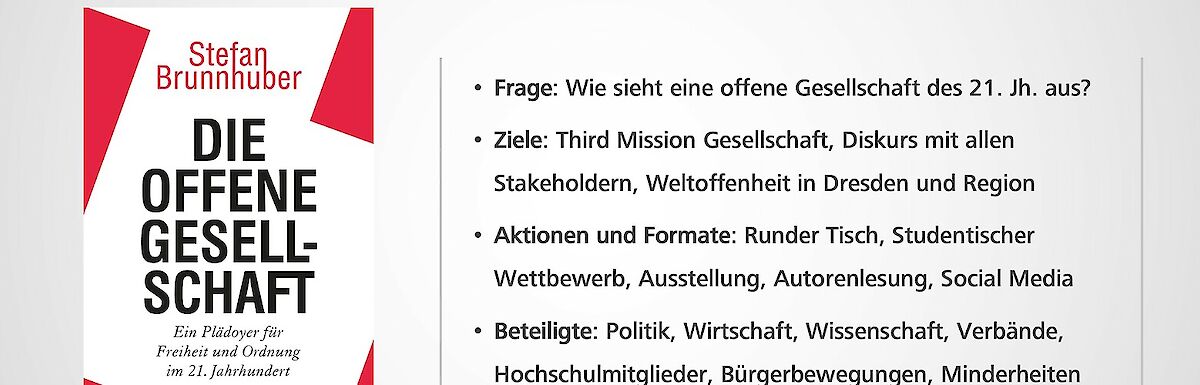
One university - One book: Open society - We help shape society!
Our university is actively engaging with Stefan Brunnhuber's book The Open Society, which highlights current social challenges and encourages reflection. Inspired by Karl R. Popper's ideas, we would like to discuss freedom, order and responsibility together with students, lecturers and partners from business and society. With lecture series, author readings, artistic activities and a student competition, we create space for creative and critical debate. As a cosmopolitan university, our aim is to provide impetus for sustainable change in Dresden and beyond.
UNEMI - Ecuador - Tourism & Event Management
The “FHD-UNEMI-TEM” project strengthens cooperation between Fachhochschule Dresden (FHD) and the Universidad Estatal del Milagro (UNEMI) in Ecuador. The aim is to develop a joint degree course in “Sustainable Tourism & Event Management” that is tailored to local needs in a practical way. Networking with companies and public institutions will ensure a sustainable transfer of knowledge. With its growing tourism industry and sustainable development goals, Ecuador offers ideal conditions for this project. The project contributes to the structural strengthening of teaching at UNEMI and promotes the further training of academic staff. In addition, both universities benefit from international exchange in research and teaching. As a key industry, tourism can have a positive impact on local infrastructure, education and health.

IN-Tour: INclusive TOURism professions. European curricula for accessible tourism manager and frontline staff
The Erasmus+ project IN-Tour is revolutionizing qualification in the field of accessible tourism in Europe. The aim is to develop a European curriculum for tourism managers (EQF 6) and service employees (EQF 5) that meets the requirements of inclusive tourism. People with disabilities and special needs should be able to participate fully in tourism experiences in the future. The project combines social responsibility with economic benefits and strengthens the competitiveness of the European tourism sector. A flexible, modular training system is being created that can be used in all EU member states. Dresden University of Applied Sciences (FHD) is contributing to the successful implementation by developing digital teaching materials and testing the curricula. With strong partners from science and practice, IN-Tour is setting new standards for an accessible tourism industry in Europe.

GATE:VET - using GAmification in TEaching at VET schools
The Erasmus+ project aims to develop an innovative qualification and communication platform for the use of gamification elements in vocational education and training. By providing best-practice examples on a user-friendly platform, teachers should be able to easily integrate playful learning methods into their lessons. A particular focus is on intuitive usability to enable teachers to get started without a great deal of training. Lack of time is a major hurdle for teachers - this is exactly where GATE:VET comes in. Building a sustainable online community ensures that the platform remains alive and is continuously expanded even after the end of the project.

School absenteeism
More and more young people are not finding a place in the existing school system - the number of early school leavers is rising continuously throughout Germany. In Saxony, around 8.5 percent of all school leavers in 2018 did not graduate. At the same time, proceedings for unexcused absences are increasing dramatically. Against this backdrop, the FHD supports the Dresden Youth Welfare Office in developing sustainable strategies against truancy. A central focus is on evaluating the street school run by Treberhilfe Dresden e.V., which offers young people alternative educational paths through socio-educational support. In addition, the FHD supports the “Fachstelle Schulabsentismus” and contributes to the networking of relevant stakeholders through scientific analyses.

HotelAcademy
As part of the Erasmus+-funded “HotelAcademy” project, Dresden University of Applied Sciences is developing innovative teaching concepts for hospitality management together with partner universities from France and Cyprus. The aim is to create a future-oriented framework that combines modern digital educational technologies such as VR-supported cooperation formats, mobile learning support and business games. The cross-university collaboration will test practical and interactive learning formats that optimally prepare students for the challenges of the industry. The project runs from September 2019 to December 2021 and is funded with EUR 68,488. HotelAcademy is creating a model for digital teaching innovations in the hotel industry that can be applied throughout Europe.
Shift plan 4.0
How can shift plans in long-term care be designed more efficiently? In the “Duty roster 4.0” project, Dresden University of Applied Sciences is working with ASB Neustadt to research how to better record and analyze downtime in care facilities. The aim is to identify correlations between working hours, age and occupational groups in order to develop tailor-made personnel strategies. Targeted data evaluations will be used to create individual downtime concepts and test them in practice. Innovative approaches will be used to optimize staff scheduling in the care sector - for greater efficiency and better working conditions.

DOmIcILE-VR - Digital training courses in the real estate industry using virtual reality
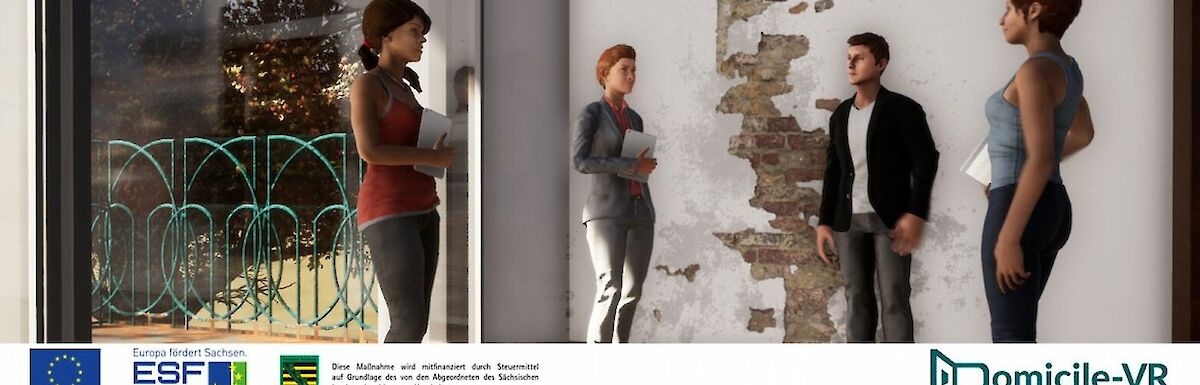
The DOmIcILE-VR project is developing a digital training program for the real estate industry that uses virtual reality to provide practical training. The aim is to qualify real estate professionals and career changers through an interactive, location-independent VR learning environment. In a realistic 3D model of an apartment, participants train how to inspect and hand over a property - from identifying defects to professional communication. Virtual role-playing games allow tenants and landlords to switch roles flexibly and test out conflict situations. This strengthens the ability to act and reduces typical sources of error. Companies benefit from efficient, online-supported training without long downtimes.
SIMPROMAT 2
How can research results be transferred into practice more quickly and in a more targeted manner? The BMBF-funded project is developing new ways of collaborating in materials research. Under the leadership of the Leibniz Institute of Polymer Research (IPF), renowned partners such as the Materialforschungsverbund Dresden e. V. (MFD) and the Fraunhofer Group MATERIALS are working on innovative transfer formats. The focus is on the Material Demo Lab, a virtual space for collaborative prototype development and business modeling. Solutions for real challenges are developed here together with industry partners. SIMPROMAT 2 facilitates interdisciplinary collaboration with new tools, exchange programs and the Science Connector as a central interface. This creates innovations at the interface of different disciplines - for sustainable and application-oriented materials research.

DiBBLoK - Diffusion of digital technologies in vocational education and training through cooperation between learning venues
DiBBLoK researches how digital technologies can be successfully integrated into vocational education and training - in particular through cooperation between vocational schools, companies and learners. The aim is to identify factors that promote and hinder digitalization and to develop practical solutions. Digital media offer great potential for networking learning locations, creating a common information base and improving communication. The project investigates what influence management structures have on the implementation of digital processes and what role they play as drivers or obstacles. Both qualitative and quantitative methods are used. By working closely with universities and research institutions, DiBBLoK contributes to the sustainable digitalization of vocational training and supports innovative training processes.

Development of the Kamenz 2030 vision
In the project, the future of the Lessingstadt Kamenz is being shaped in an open and citizen-involved process. With the support of citizens, visions and concrete goals for urban development are being developed that will serve as a basis for future decisions. The aim is to create a sustainable and future-proof model that includes all parts of the city and provides new impetus for regional development.

RENYO: Re-engaging young offenders with education and learning
The RENYO project addresses the question of how young offenders can be reintegrated into education and learning processes. Using the “Authentic Inquiry” method, young people's personal interests are used as a starting point for their learning processes in order to promote deeper motivation and long-term prospects. Supported by digital learning infrastructures, access to education is facilitated and a sustainable learning process is ensured beyond the duration of the project.