
Lina Kröber & Jasmin Kellermann
Kontakt
Campus Straßburger Platz | Raum 108
+49 351 44 45-444
studium@fh-dresden.eu

Studying opens up new perspectives – and this doesn't just apply to high school graduates. More and more people are now consciously choosing to study without a high school diploma. Those who have already completed vocational training and have been working for several years bring skills to the table that are a great advantage in university studies. But how does university admission work without a traditional university entrance qualification? What options are there, what requirements do you have to meet – and how do you find the right degree programme? In this article, you will find all the information you need to successfully navigate your own path to university without a school-leaving certificate.
Many school leavers initially opt for vocational training – whether out of conviction, due to personal circumstances or because university entrance qualifications were not an issue at the time. But what if the desire for further academic qualification arises later on?
Studying is a logical next step for people with professional experience who want to develop their skills, improve their career opportunities or open up new career fields. The good news is that in Germany, it is now possible to study in all federal states even without a school-leaving certificate – through recognised professional qualifications or special admission routes.
If you are one of those professionally qualified people who are motivated to acquire new knowledge and obtain academic degrees, there are many opportunities open to you. Universities such as the FHD (Dresden University of Applied Sciences) actively support this path – with individual study programmes, advice and clear admission procedures.
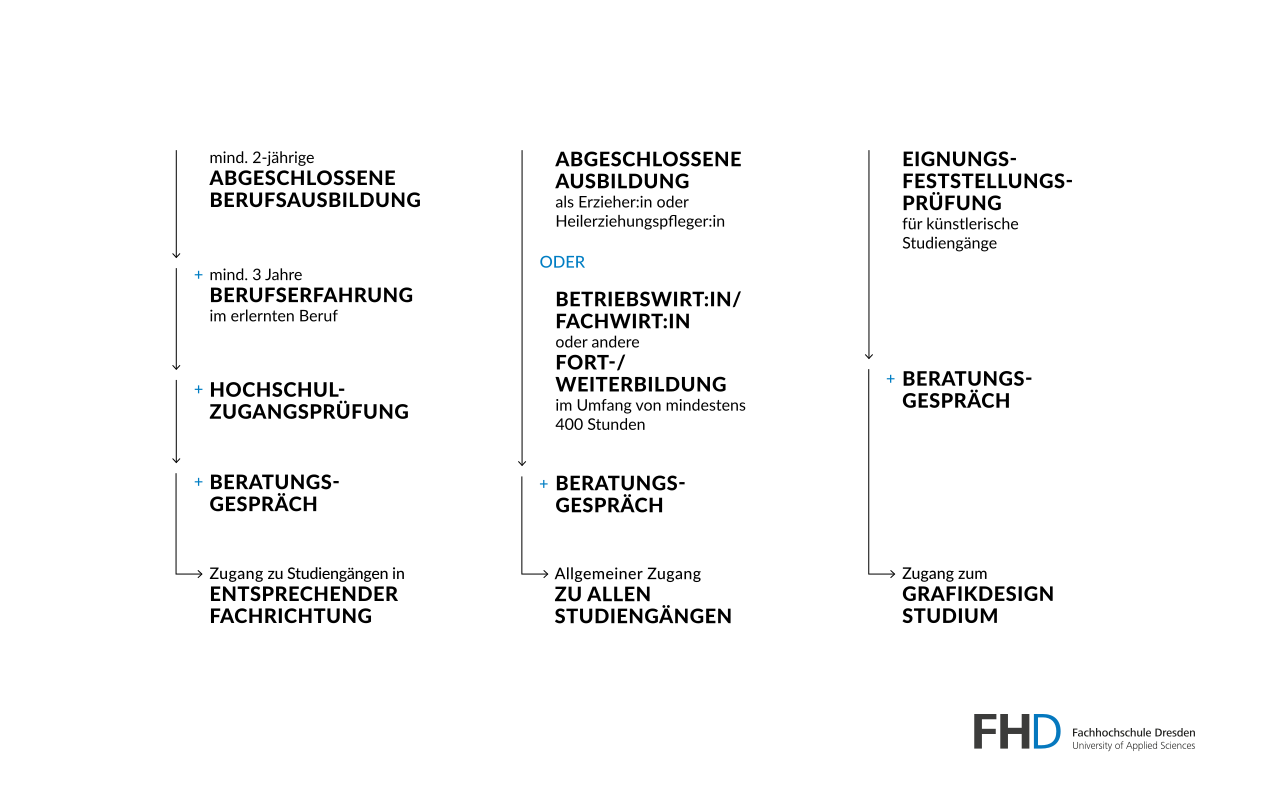
Even without a school-based university entrance qualification, it is possible to study in accordance with §18 SächsHSG with the following qualifications.
The requirements for this are completion of at least two years of state-regulated vocational training followed by at least three years of professional experience in the learned profession. In addition, a corresponding university entrance examination with a consultation at the university of applied sciences must be taken. Please register for this at the bottom of the page, but only after you have applied to us (§18 (3), No. 5, SächsHSG).
The following qualifications entitle the holder to university admission after a consultation (§18 (3), SächsHSG):
Master craftsman's examination in accordance with §18 (3) No. 1
Advanced training qualifications in accordance with §18 (3) No. 2
State certificate of competence for nautical or technical ship service in accordance with SächsHSG § 18 (3) No. 3
Qualification from technical colleges in accordance with the framework agreement on technical colleges pursuant to SächsHSG § 18 (3) No. 4, e.g. state-recognised educator/remedial therapist, state-certified technician, state-certified business economist, state-certified specialist (depending on the federal state and institution)
Qualification based on a comparable state law continuing education regulation for professions in the healthcare sector and in the field of social care and social education professions in accordance with SächsHSG § 18 (3) No. 5
Recognition of these qualifications requires that the professional training is based on at least two years of vocational training, includes advanced training, comprises at least 400 teaching hours and corresponds to a master craftsman's examination in terms of content and depth of training. The same applies to further training courses offered at state administrative and business academies that correspond to a master craftsman's examination in terms of content and depth of training (SächsHSG § 18 (3) No. 5(4).
In the degree programme "Graphic Design Screen & Print Media (B.A.)", it is possible to study without a school leaving certificate in accordance with §18 (3), No. 12 SächsHSG by demonstrating special artistic aptitude. This is proven by means of an aptitude assessment test and a counselling interview. Examination dates are arranged individually after receipt of the application.
If you have any questions, please contact our student advisory service or apply directly so that we can check your individual requirements.
There is a wide range of degree programmes for people without a high school diploma – and these are largely based on your previous professional experience. At FHD, you will find numerous practical degree programmes in the fields of economics, social sciences, health, education and design.
If you have worked in the commercial sector, a degree programme such as Business Administration or Tourism & Event Management could be a good fit. Those with a background in nursing or social work will find suitable programmes in the fields of Nursing & Health Management, Social Pedagogy or Vocational Education. Creative degree programmes such as Graphic Design or Digital Media Design are also available – here, selection is additionally based on an aptitude test with work samples.
The application process at the FHD is digital and takes place via the online portal. It is important that you submit all the necessary evidence and documents in good time – i.e. training certificates, proof of employment, any further training certificates and your CV. If you need to qualify via an entrance examination or a trial study period, you will be invited to do so separately.
The FHD offers various formats for everyday study. Classic full-time study is possible, as is part-time study, which can be easily combined with a part-time job or family commitments thanks to evening classes or block seminars. These flexible models are particularly attractive for students with professional experience.
Teaching at the FHD is characterised by small groups, a high quality of supervision and a strong practical focus. Many lecturers come from a professional background and teach content on a par with your own experience. Group work, practical projects, case studies and excursions ensure a lively, application-oriented course of study.
Studying also presents financial and organisational challenges – especially if you are already working or have family commitments. It is therefore important to consider your financing options at an early stage.
First, you should check whether you are eligible for BAföG. This is also possible for people who have completed vocational training under certain conditions – for example, if you are below a certain age limit and your income or that of your parents does not exceed certain limits.
If you have completed advanced training, you may be able to apply for Aufstiegs-BAföG (advancement BAföG) – this is independent of your parents' income and is specifically aimed at professionally qualified people who want to continue their academic education. The Aufstiegsstipendium (advancement scholarship) or the Deutschlandstipendium (Germany scholarship) are also interesting options: they support committed professionals who want to further develop their potential through study.
Another option is to finance your studies through a working student job or part-time employment in your chosen field. This allows you to remain anchored in the labour market while you study. In some cases, a student loan – for example, from KfW – can also be a sensible option, provided you use it responsibly and can secure repayment in the long term.
In addition to financing, time management is also an important factor for academic success. The FHD offers you many opportunities to organise your studies flexibly – whether through part-time models, individually plannable attendance times or hybrid learning formats. It is important that you set realistic goals and organise yourself well. Tools such as digital calendars, to-do lists and study groups can help you keep track of things and maintain your motivation.
In addition, studying without a school-leaving certificate also brings personal development: you learn to work scientifically, to question content, to develop new ways of thinking – and you unfold your potential in a whole new context. Many students report that taking the step to study not only advances their careers, but also strengthens their self-confidence and gives them new perspectives on their lives.
Many people believe that studying at university without a school leaving certificate is too difficult or even impossible – this is incorrect. You don't need perfect school grades, years of preparation or above-average marks to study successfully.
What you don't need:
● You don't need a "traditional" secondary school leaving certificate.
● You don't have to be a maths genius.
● You don't have to study full-time right away.
● You don't need a large amount of start-up capital.
What counts is motivation, perseverance, clear goals – and a willingness to engage with new content. Studying requires discipline and stamina, but people with professional experience often have precisely these skills. The FHD provides targeted support to help you master the transition to the academic world – with preparatory courses, advice and practical teaching.
To ensure that your application to study without a school leaving certificate is complete, you should prepare the following documents:
● Proof of completed vocational training (e.g. journeyman's certificate, examination certificate)
● Proof of professional activity (employment contracts, proof of employment, employment references)
● If applicable, certificate of completion of your advanced training (e.g. master craftsman's certificate, IHK certificate)
● Tabular CV with all professional positions
● For creative degree programmes: work samples or portfolio
● For the entrance examination (if required): registration for the examination date
Prepare your documents carefully and ensure they are legible and complete. If you are unsure about anything, you can contact the FHD student advisory service at any time – they will help you put everything together and let you know if anything is missing or needs to be adjusted.
Whether you are in your early 20s, have just started a family or want to relaunch your career at 40, it is never too late to study. More and more universities, including the FHD, are deliberately opening their doors to professionally qualified students who are pursuing their own unique paths.
The average age of many degree programmes is shifting – especially in part-time or practice-oriented formats. So you are not alone if you are a "late starter". Experience shows that older students often bring more focus, perseverance and goal orientation to their studies. They know why they are studying – and they really want to make a difference.
In addition, modern learning formats help to reconcile studies and life. Digital tools, hybrid events, flexible examination formats and targeted support services make studying feasible even in complex life situations.
In the modern world of work, it is not only university degrees that are becoming increasingly important – it is above all the combination of practical professional experience and academic qualifications. This is exactly where studying without a school-leaving certificate comes in: you already have specialist knowledge and industry expertise, and your studies will give you additional methodological, strategic and theoretical skills.
Employers value graduates who have acquired their training in a company or in practice. You know how everyday working life works, can assess processes and make decisions that are based not only on textbooks but also on real-life conditions. With a degree – for example in economics, social pedagogy or design – you will develop into a sought-after specialist with interdisciplinary skills.
Your dual qualifications (vocational training + degree) also make you ideally prepared for project management, management positions or consulting. Many organisations, especially small and medium-sized enterprises, are looking for exactly this kind of profile, which combines specialist knowledge with leadership potential.
Just a few years ago, studying without a school leaving certificate was the exception – today, it is part of the normal offering at many universities and technical colleges. This is not only due to legal changes, but also to social change: academic education is increasingly being opened up to professionally qualified people because their knowledge and perspectives are needed.
Many universities – including the FHD – have deliberately simplified and adapted their processes. There are now:
● clearly regulated admission routes for experienced professionals,
● transparent examination requirements,
● targeted support services for starting a degree programme,
● flexible study models that take working hours and family commitments into account.
These changes create genuine equality of opportunity and enable people with professional backgrounds to start on an equal footing with traditional first-year students. It is no longer a question of creating barriers – but of creating access. If you are ready to take this path, you will find better conditions today than ever before.
Choosing the right degree programme is crucial for your long-term success – and should be carefully considered. It's not just about what interests you, but also what fits in with your career path so far and what prospects you are aiming for after graduation.
Ask yourself:
● What professional experience do I have?
● In which areas have I felt comfortable so far?
● Where do I see myself in five to ten years?
● Do I want to advance in my professional field – or dare to change direction?
If you have worked in nursing, for example, you might consider studying nursing and health management. If you have worked as a commercial employee, business administration or management-oriented courses are a good option. Those who work in the creative industry or have a talent for design can consider design or communication sciences.
The student advisory service at FHD will help you to systematically clarify these questions. Online study orientation tests, trial lectures and information days can also help you to gain a realistic picture.
The first step towards studying often begins with good advice. At FHD, you receive individual support – online or on site, by telephone or video. The student advisory service helps you:
● find out whether you meet all the requirements,
● choose the right degree programme,
● go through the application process correctly,
● plan your financing options realistically,
● clarify any uncertainties (e.g. regarding the entrance examination).
A personal assessment is particularly worthwhile when it comes to the question of whether your previous career path is compatible with your desired degree programme. You will receive a clear roadmap and know exactly what the next steps are – from application to enrolment.
If you wish, you can also attend taster events or arrange a personal consultation with a programme director. This will give you an authentic impression of everyday student life and enable you to make an informed decision.
Want to take the next step? Then find out now about your study options without a school leaving certificate at Dresden University of Applied Sciences.
Lina Kröber & Jasmin Kellermann
Kontakt
Campus Straßburger Platz | Raum 108
+49 351 44 45-444
studium@fh-dresden.eu