
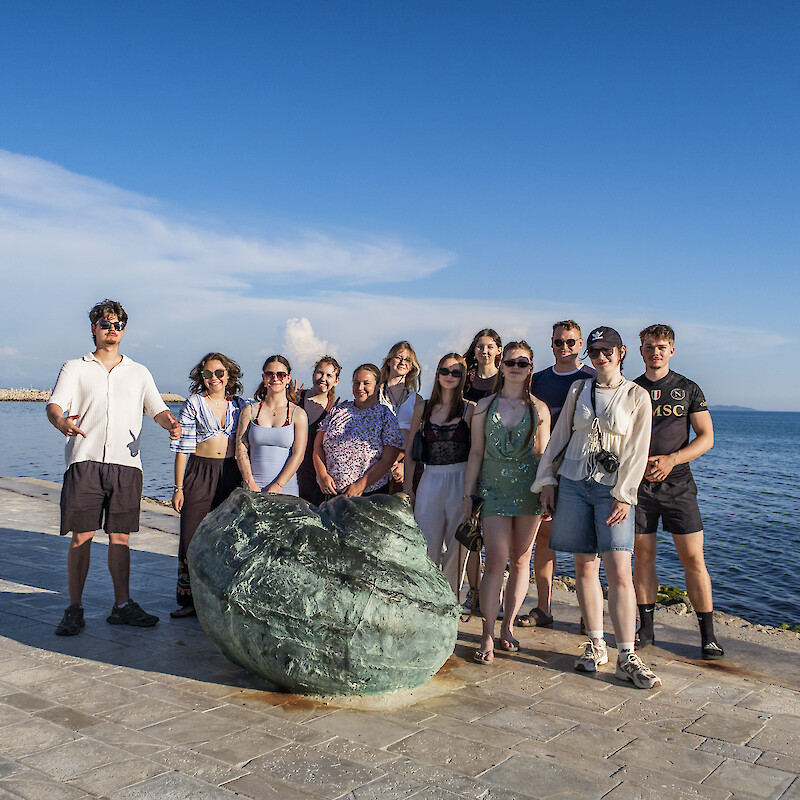
“Those who are prepared to embrace the new and the unknown often gain more experience than even the most detailed plan could ever provide.”
Hanna Kästner, BA24


FHD students who plan to study or do an internship abroad for one or two semesters are called outgoings.
On the following pages, you will find important tips and information regarding study-related stays abroad. If you have any questions or require assistance, please contact the International Office after registering in advance.
All students have the opportunity to study at a university abroad for one or two semesters or to write their thesis there. The FHD has a constantly growing network of university partnerships for this purpose.
Find out more about our partner universities on the website or contact the International Office directly, where you will be guided through the entire application process.
You can also choose a university for your semester abroad or your thesis that does not have an existing partnership with us. In this case, you are a so-called free mover and must apply independently. Please note the requirements, deadlines and regulations of the host university. If you have any questions, please contact the International Office after registering in advance.
Courses must be attended during the semester abroad. Please note that the content of courses at the host university may differ from the modules in the FHD study regulations.
For your learning agreement, please contact your academic advisor or the programme director in your department – alternatively, you can also obtain information from the International Office.
Make sure that you have a sufficient command of the language(s) of instruction to be able to follow the classes. The language requirements can usually be found directly on the website of the host university.
For students who would like to gain international experience, an internship semester abroad is also a good option.
Information on vacancies and opportunities for internships abroad is available from the Career Service, your faculty or the International Office. Also
, keep an eye on the FHD notice boards and ILIAS for regular updates.
You are responsible for finding an internship position in a foreign company yourself.
In addition to the Career Service and the International Office, you can also enquire about suitable vacancies at your faculty. The notices on the
university's notice boards are also updated regularly, so be sure to check them as well.
If your practical semester abroad meets the conditions of the FHD internship regulations, there are usually no problems with recognition.
Before starting your internship, contact the Career Service, your programme director or the Examinations Office to find out about the necessary formalities (e.g. internship contract, internship report, confirmation from the employer).
The International Office and Career Service also provide sample internship contracts in English.
Your internship must last at least two months and no more than twelve months. Both compulsory and optional
internships are eligible for funding. Graduates
can also complete an internship under Erasmus+ for up to one year after graduation.
The main advantages of the programme are:
Not all students are able to spend time abroad whilst studying – particularly those who work or have children. However, there is the option of choosing short stays abroad, so that you can still take the opportunity to get to know other universities, students from other countries and different academic perspectives.
Don’t forget: there is always the option of applying for a grant to cover travel and course fees.
Short courses are courses that last for less than a semester. Many universities offer them during the holidays or even during the semester. They usually last two months, though there are also courses lasting just two weeks. Summer schools also count as short courses and usually last four weeks.
If you’re interested in a short course, you can look for a suitable programme yourself or with the help of the International Office, which will also handle the registration process.
As always, you can apply for a scholarship to cover your travel costs.
Advantages of a short course:
Can be completed during the holidays without interrupting your studies at the FHD.
You’ll get to know another university, its students and staff, as well as new methods and perspectives, and make valuable contacts.
You’ll improve your language and intercultural skills and get to know a new culture and way of life.
Benefits of a BIP:
Can be completed during the holidays without interrupting your studies at the FHD.
Thanks to the specific academic topic, you can deepen your knowledge in an area that is particularly relevant to your academic and professional future.
You’ll get to know another university, its students and staff, as well as new methods and perspectives, and forge valuable contacts.
You’ll improve your language and intercultural skills and get to know a new culture and way of life.

With the support of the Erasmus grant, you can organise group trips with other students to events, universities, festivals, etc., that are relevant to your studies. Check with the International Office to find out what opportunities are available for travelling with your group and your lecturer to deepen your knowledge of a topic that interests you.
Whether in Thailand, Portugal or another country of your choice – you can write your final thesis abroad and fund the trip with a grant. This way, you’ll round off your studies with an unforgettable academic experience abroad.
You can take between 2 and 6 months to complete your thesis. Be sure to clarify the conditions with your supervisor (SGL) beforehand and organise the trip together with the International Office.
Mastering another language opens up new opportunities for you, both professionally and personally, to get to know clients, cultures and people. Language courses abroad are therefore an excellent opportunity to improve your English or learn a new language.
Learning in another country is particularly effective: you’ll develop intercultural skills, overcome your shyness about speaking another language, and enjoy many other benefits. The course does not have to be taught in the local language – for example, you could take an English course in Málaga (Spain) or in Bali.
Don’t forget: if your course lasts three weeks or more, you can apply for a grant to cover your travel and course costs.
You can look for a language school yourself, enquire at the International Office about partner institutions, or take advantage of EF Language Travel’s programmes (our students receive a discount):
Language trips & language courses abroad | EF Language Travel
Studying abroad during your degree can mean additional financial costs.
To ensure that this does not prevent you from pursuing your plans, you should find out about the various financing and funding options available at an early stage.
For a one-semester study abroad programme, it is advisable to allow eight to twelve months for research and planning.
There are various ways to finance a study visit, internship, thesis or language course abroad, for example:
SCHOLARSHIP |
| Contact |
ERASMUS Leonardo Office Saxony – Scholarships for internships abroad |
| |
DAAD – HAW HAW.International: Internships abroad for students - DAAD - German Academic Exchange Service |
| |
FHD – DAAD PROMOS PROMOS – Programme to increase the mobility of students at German universities – DAAD |
| |
Index of German foundations |
| |
myStipendium scholarship database |
| |
SAB Saxon Development Bank |
| |
BAföG for studying abroad |
| |
Education loan: |
|
Comprehensive information on funding opportunities, calls for applications, deadlines and application forms can be found on the website of the German Academic Exchange Service (DAAD).
There you will also find a scholarship database with all funding programmes.
Tip: Take a look at the notices in the International Office display case, where you will always find the latest calls for applications.
BAföG abroad
Depending on the destination country, different authorities are responsible for processing BAföG applications for study abroad – these are not always student services. You
can find the relevant authority for your country on the BAföG server of the Federal Ministry of Education and Research (BMBF).
Internships abroad are also eligible for funding, provided they are relevant to your studies. For
more information, visit www.auslandsbafoeg.de or contact the relevant office for educational funding.
There are also various options for finding accommodation during a semester abroad or internship abroad:
In very rare cases, you will automatically be allocated a place in a hall of residence when you register at the university. You should
therefore start looking for accommodation at least 2–3 months before the start of your stay abroad.
Our partner Erasmus Play – the accommodation search engine for students – offers helpful support.
It brings together verified accommodation from the most important accommodation platforms in more than 520 cities and is particularly useful for outgoing students with different travel destinations.
The booking process is simple:

Special residence regulations generally apply to internships and longer stays outside the European Union.
Please obtain information in good time from the embassies or consulates of the destination country or on the website of the Foreign Office.
If you are planning a stay abroad, you should carefully inform yourself about the conditions in the host country or your destination region. Please
note the general travel advice provided by the Foreign Office.
Before you go abroad, check with your health insurance company to see whether your health insurance cover is also valid abroad. Additional
cover may be advisable. You can
obtain information from:
from your health insurance provider
from consumer portals such as mawista.com
on the DAAD website
In some cases, you will need to take out health insurance directly through the foreign university.
You should also consider taking out private accident and liability insurance for the duration of your stay abroad.
Make sure that medical repatriation to your home country is also covered in case of an emergency.
Accident and liability insurance is particularly useful for internships abroad .
It is best to check with your existing insurance company first to see whether your cover is also valid abroad before taking out a new policy.
The German Academic Exchange Service (DAAD) offers students, interns and researchers who are going abroad from Germany affordable combined health, accident and personal liability insurance through its group contract.
Detailed information can be found on the DAAD website.
Dresden University of Applied Sciences offers students a wide range of opportunities to study or do an internship abroad. As an Erasmus+ partner university, we are part of the largest European funding programme for international mobility. In addition, the DAAD (German Academic Exchange Service) supports us as a national agency in organising and financing stays abroad.
Through close cooperation between FHD, Erasmus+ and DAAD, we enable you to study abroad smoothly and with the best possible support. This allows you to promote your academic and personal development in a targeted manner while making international contacts.

“Those who are prepared to embrace the new and the unknown often gain more experience than even the most detailed plan could ever provide.”
Hanna Kästner, BA24

“Some countries don’t make it onto your travel list until you’ve visited them and realised you should have discovered them much sooner.”
Rosi Müller, SPM24

“I’m incredibly grateful for this trip! As well as the fascinating professional insights, it was great fun exploring the country together as a group.”
Lara Schulze, MCD26

Paola Yaconis
Kontakt
Campus Straßburger Platz | Raum 120
Tel +49 351 44 45-417
p.yaconis@fh-dresden.eu

Chi Ziesmann
Kontakt
Campus Straßburger Platz | Raum 010
Tel +49 351 44 45-407
c.ziesmann@fh-dresden.eu

