
Chair in Media Informatics, specialising in interactive programming and game development
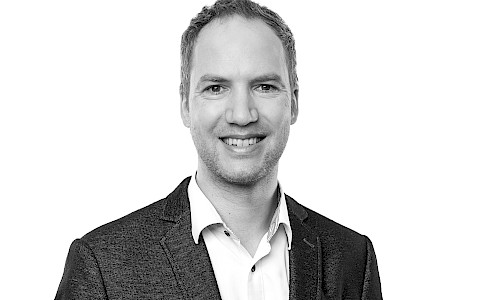
Prof. Dr. Marius Brade
Kontakt
Campus Straßburger Platz | Raum 503
Tel +49 351 44 45-409
m.brade@fh-dresden.eu

“How will we learn in the future?” Under this central guiding question, the 2026 Dies Academicus at Dresden University of Applied Sciences in the spring set the course for the future of study and teaching: What skills do graduates need in a world of work characterised by artificial intelligence, digitalisation and constant change?
Next week, this debate will be taken up at the “Brains on Silicon 2026” conference. Under the theme “Closing the implementation gap”, the tech sector will continue the discussion precisely where the FHD has already developed answers.
One of the panels in the conference programme got underway right on Straßburger Platz. Back in March 2026, the FHD initiated an open dialogue between academia and regional IT companies such as queo, ACP Group and Steinbeis.
There, senior managers described their day-to-day work: development teams are writing less and less of their own code and are instead primarily checking AI outputs. This increases the workload involved in quality control and takes up a great deal of time. Prof. Dr.-Ing. Marius Brade and Manja Unger-Büttner are now bringing the insights gained from this exchange to the conference stage, together with the participants of the working group.
11.40–11.50 (Stage 4) | Keynote presentation:
‘Vision: The Education Framework for the AI Age’
Prof. Dr.-Ing. Marius Brade will speak on the reorientation of university teaching away from pure syntax generation towards precise requirements analysis, user-centred design and critical review.
12:00 to 12:45 (Stage 4) | Panel discussion:
‘A compass rather than code: How and what do we need to learn in the AI era?’
Prof. Dr Marius Brade discusses key decisions in education policy alongside Robert Denk (SMWK), Prof. Dr Wolfgang Lehner (TU Dresden / German Science Council) and Prof. Dr Matthias Vodel (Mittweida University of Applied Sciences).
4.00 pm to 4.25 pm (Stage 3) | Panel discussion:
“Between a flood of output and the search for meaning: What skills do development teams need today?”
The working group, launched at the FHD, presents approaches to tackling cognitive overload and so-called ‘code waste’ in the day-to-day work of developers.
The programme items at Brains on Silicon highlight what really matters in practice: anyone who does not want to be overwhelmed by generative AI in their professional life needs sound judgement and direction. This topic was already examined in depth at Dresden University of Applied Sciences during the Dies Academicus in the spring.
Under the guiding principle ‘Shaping the future, rethinking teaching’, five ‘future skills’ clusters were defined, which form the foundation of future-proof degree programmes: Human-Tech Collaboration, Critical Thinking, Creative Confidence, Empathy & Care, and Adaptive Learning. These clusters prepare students in a practical way for the changing demands of tomorrow’s world of work. Artificial intelligence serves as a tool in this process, whilst professional and ethical judgement remains with humans.
Three examples illustrate how this approach is embedded in everyday student life at Dresden University of Applied Sciences:
On the Bachelor’s degree programme in Digital Media Design, students programme playable prototypes in a short space of time during the Game Jam. Generative tools assist with scripts, logic blocks and visual designs. However, no software can pass the real test on its own: pupils from the Academy for Vocational Education and Training (AFBB) test the games directly on campus. It is the unfiltered feedback from the test players that determines whether the game mechanics, frustration levels and overall enjoyment work. Students must meet these real-world requirements in their developments and incorporate the feedback iteratively into their game design. In this way, they specifically develop their skills in the areas of human-tech collaboration and creative confidence.


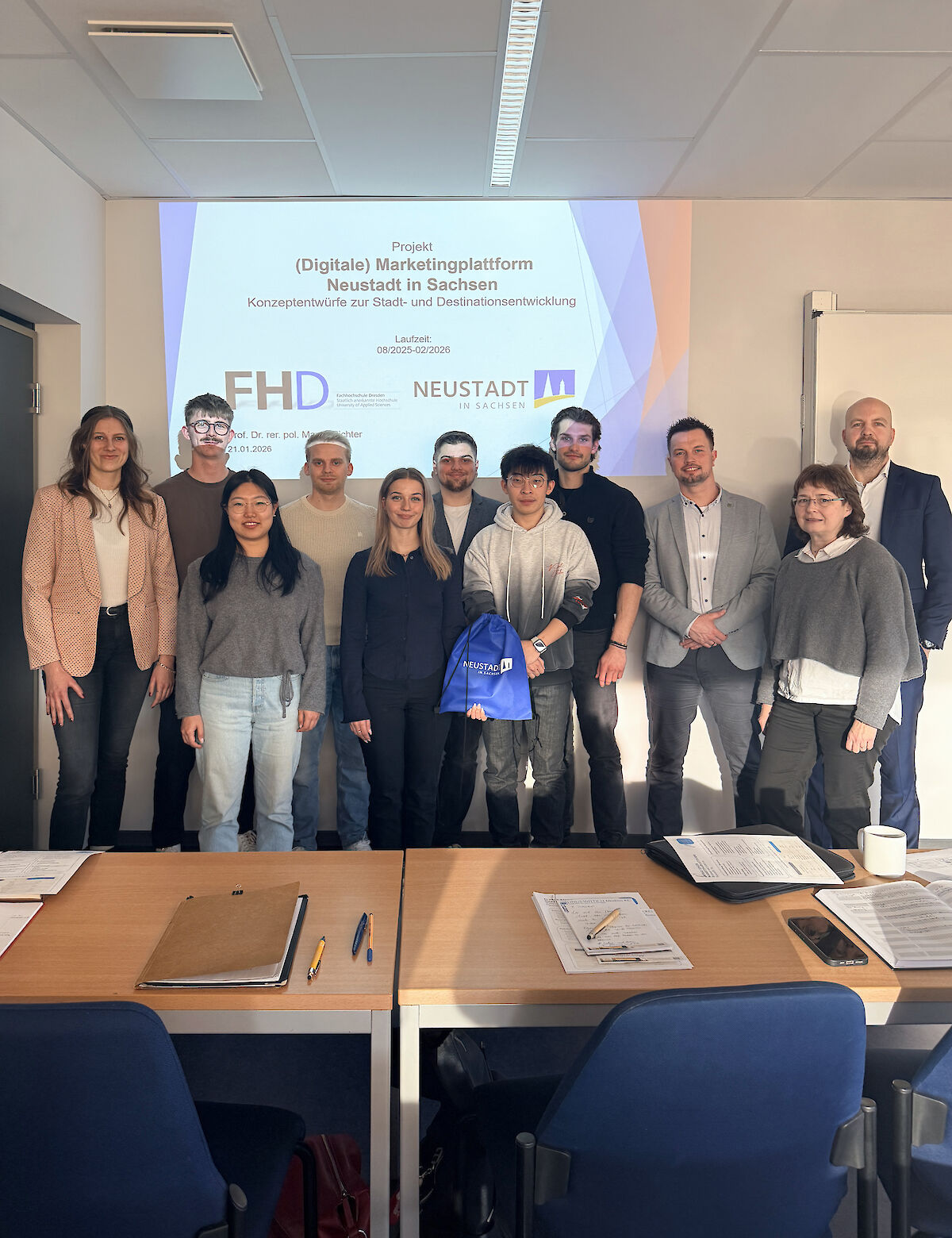
AI also provides market analyses, target audience profiles and landing page designs for the Tourism & Event Management and Business Administration degree programmes. A practical project for the town of Neustadt in Saxony demonstrated just how reliable such data is: at the final presentation to decision-makers from the town council and the tourism sector, it was not automated designs that counted, but fixed budget allocations, local interests and personal negotiating skills on the ground. This helps students hone their critical thinking skills: they learn to methodically scrutinise data sources and to justify economic decisions on a sound basis.


In the degree programmes in Social Pedagogy & Management and Nursing & Health Management, digital tools assist with duty rosters and the structuring of case documentation. Yet the core task remains interpersonal. As Prof. Dr Markus Andrä emphasises in his latest academic publication on professional conduct, social work requires ongoing critical self-reflection. Ethical decisions in child protection or the personal support of patients at their bedsides cannot be delegated to algorithms. The degree programmes incorporate the field of ‘Empathy & Care’ to ensure a future-proof integration of human care and modern management processes.
Artificial intelligence does not replace human expertise, but rather enhances the importance of judgement, empathy and an understanding of systems. Anyone wishing to see how academia and the regional economy are jointly shaping this transformation can meet our lecturers on 14 September at Brains on Silicon 2026.
Prof. Dr. Marius Brade
Kontakt
Campus Straßburger Platz | Raum 503
Tel +49 351 44 45-409
m.brade@fh-dresden.eu

Manja Unger-Büttner
Kontakt
Campus Straßburger Platz | Raum 415
Tel +49 351 4445-465
m.unger-buettner@fh-dresden.eu