
Rector
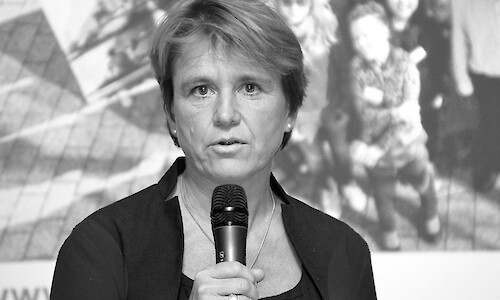
Dr Heike Zimmermann-Timm
Kontakt
Campus Straßburger Platz | Raum 506
Tel +49 351 44 45 415
h.zimmermann-timm@fh-dresden.eu

How can scientific findings help shape the teaching of tomorrow? The Dresden University of Applied Sciences (FHD) sees itself as a university that combines science, innovation, and social responsibility.
A current example of this is provided by our Rector, Dr. habil. Heike Zimmermann-Timm, with three contributions to the newly published standard work “Climate Warning Signals: Agriculture”.
The contributions address the major transformation challenges of our time: How can agriculture, the environment, and society be made more sustainable? What role do healthy soils, intact water systems, and resilient ecosystems play? How can scientific findings be translated into concrete solutions for business and society?
One focus is on regenerative agriculture. It goes beyond the traditional concept of sustainability and aims to actively restore soils, ecosystems, and natural cycles. Regeneration therefore means not only environmental protection, but also economic resilience, systems thinking, and long-term viability. These are topics that are increasingly shaping business, politics, and education.
Another contribution highlights the close links between agriculture and water protection. Heat waves, heavy rainfall, and periods of drought often affect lakes and rivers before changes become visible in the landscape. Water bodies are therefore important early warning systems for climate change.
“Successful sustainable transformation can only be achieved if we consider ecological, economic, and social interrelationships together. This is exactly the kind of systems thinking we also need in higher education.”
— Dr. habil. Heike Zimmermann-Timm
A third contribution focuses on Nepal and demonstrates how closely agriculture, food security, and climate change are interconnected worldwide. Together, these three contributions show that the challenges of the 21st century can only be understood and addressed through interdisciplinary approaches.
The Dresden University of Applied Sciences understands scientific knowledge as the foundation of modern higher education. International research experience is systematically integrated into studies and teaching, strengthening the transfer between science, business, and society.
Regenerative agriculture is an example of the challenges of our time: It combines ecological, economic, technological, and social questions. This systems perspective also shapes teaching at the Dresden University of Applied Sciences. Students are encouraged to understand complex interrelationships, connect different disciplines, and develop viable solutions for the transformation of business and society.
With its four departments of Business Administration, Design, Nursing, and Social Sciences, the Dresden University of Applied Sciences promotes interdisciplinary thinking and future-oriented action. Sustainability, digitalization, innovation, and social responsibility are taught across disciplines and implemented in practical projects.
“Our aim at the Dresden University of Applied Sciences is to translate scientific findings into education, innovation, and social responsibility. We want to empower our students to actively shape the future – with expertise, systems thinking, and a willingness to take responsibility.”
— Dr. habil. Heike Zimmermann-Timm
In this way, the Dresden University of Applied Sciences combines scientific excellence with innovative teaching and prepares its students to actively contribute to the sustainable transformation of business and society.
“Climate Warning Signals: Agriculture” is the latest volume in the renowned book series “Climate Warning Signals”, published in cooperation with GEO. The volume brings together contributions from leading scientists on the impacts of climate change on agriculture, soils, water, and food systems.
According to the editor Dr. José L. Lozán, the volume closes a scientific gap by bringing these topics together for the first time in a compact scientific reference work.
Dr. habil. Heike Zimmermann-Timm contributes three chapters:
Dr Heike Zimmermann-Timm
Kontakt
Campus Straßburger Platz | Raum 506
Tel +49 351 44 45 415
h.zimmermann-timm@fh-dresden.eu