

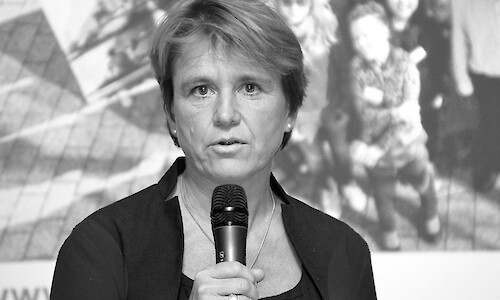
Rector
Dr Heike Zimmermann-Timm
Kontakt
Campus Straßburger Platz | Raum 506
Tel +49 351 44 45 415
h.zimmermann-timm@fh-dresden.eu

The water level of the Elbe is exceptionally low. Dr Heike Zimmermann-Timm, Rector of Dresden University of Applied Sciences and a limnologist, explains the consequences this has for the river, Dresden’s smaller water bodies and the city’s climate in a recent article in the *Sächsische Zeitung*.
“Water bodies act as environmental sentinels. The Elbe shows the people of Dresden first-hand what is happening throughout the entire catchment area,” explains Heike Zimmermann-Timm. Low water levels, rising water temperatures, drying-up tributaries and polluted urban green spaces are not separate developments, but rather the consequences of a changed landscape water balance.
In the article, the limnologist provides a scientific analysis of the current situation and demonstrates how drought affects the habitats of aquatic plants and animals. The consequences for Dresden are also becoming apparent: dry soil, dry Elbe meadows, and green spaces are losing some of their natural cooling effect. As a result, the city can heat up more and has greater difficulty cooling down at night.
At the same time, the current drought highlights that sustainability extends far beyond nature conservation and water protection. It concerns economic decisions, the design of climate-adapted living spaces, as well as social and health issues.
This also calls upon three faculties at the FHD: the Faculty of Business Administration focuses on the responsible use of resources and resilient organisations; the Faculty of Design on the design of sustainable products, spaces and communication; and the Faculty of Applied Social Sciences on the social and health consequences of climate change.
It is precisely in the interplay of these perspectives that the strength of Dresden University of Applied Sciences lies: sustainable solutions emerge where ecological challenges are considered alongside their economic, design-related and social implications.
Dr Heike Zimmermann-Timm
Kontakt
Campus Straßburger Platz | Raum 506
Tel +49 351 44 45 415
h.zimmermann-timm@fh-dresden.eu